
Chicago Snow Parking Restrictions in Winter: How the Overnight Ban + “2-Inch” Snow Routes Actually Work (and how not to get towed)
Chicago winter driving isn’t just about snow tires and scraping a windshield—it’s about parking signs that can tow your car while you sleep. The city has a seasonal overnight ban on specific main streets, plus separate “snow route” rules that can kick in when snow accumulates. Get either wrong and you can be paying towing, ticket, and storage fees fast.
This post breaks down what the restrictions mean in plain English, when it makes sense to bring a car anyway, and the best winter parking tips for travelers who don’t want to spend a vacation morning hunting for an auto pound.
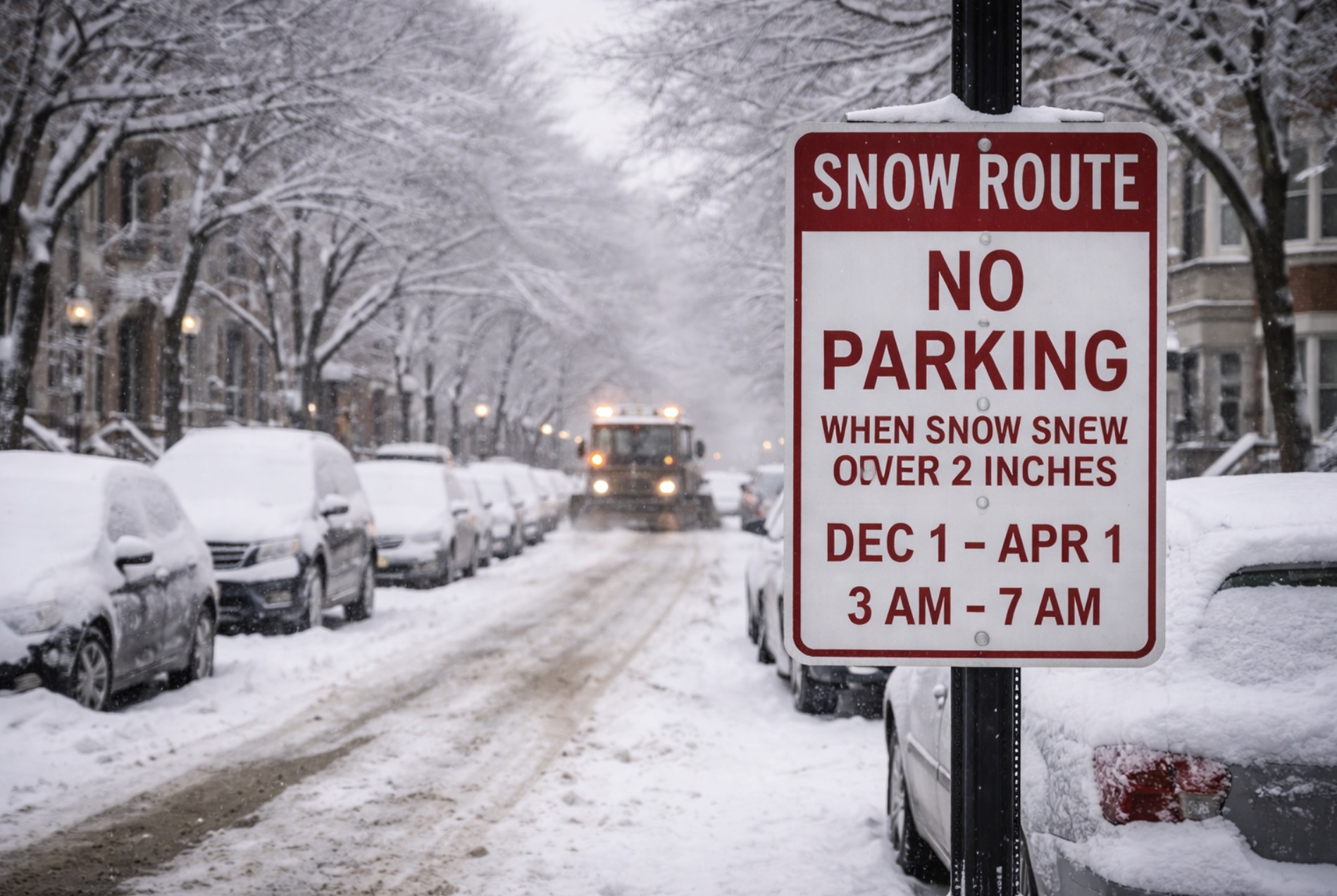
| Short answer | In winter, assume two big “tow-risk” rules: no parking on designated main streets from 3:00–7:00 a.m. between Dec 1 and Apr 1, and no parking on Snow Route streets when 2+ inches of snow is on the street. If you can’t verify your block, choose off-street parking. |
|---|---|
| Best for | Travelers who can reserve off-street parking (garage/lot/hotel parking) or who don’t mind treating street parking as a daily task: checking signs, watching snow, and moving the car when needed. |
| Not ideal for | Anyone planning “set-it-and-forget-it” street parking—especially overnight—during Dec 1–Apr 1 or during/after snow events. |
| Bottom line | If towing would wreck your trip, don’t gamble on street signs. In winter, paid off-street parking often costs less than the minimum tow + ticket + first day of storage. |
Here’s the decision logic: Chicago’s winter overnight parking ban applies on designated main streets nightly from 3:00 a.m. to 7:00 a.m. between December 1 and April 1. Separately, Snow Route restrictions can apply when there’s 2 inches or more snow on the street, regardless of time of day. If you’re visiting, the lowest-stress move is to plan a garage/lot overnight and use street parking only when you’ve clearly verified the signs for that exact block.
✅ When it makes sense
- You have guaranteed off-street parking (hotel garage, reserved spot, paid lot), so you’re not relying on overnight street parking during the ban period.
- You’re using the car for a specific purpose (day trip, family logistics) but can park it off-street overnight and avoid the 3:00–7:00 a.m. risk window.
- You’re comfortable doing “winter parking admin”: reading signs carefully, saving a photo of the sign, setting reminders, and moving the car if needed before restricted hours.
- You’re traveling with gear (or mobility needs) where rideshare/transit isn’t ideal, and you’ve budgeted for parking so you’re not tempted into a high-risk spot.
🚫 When it doesn’t
- You’re planning to rely on overnight street parking and won’t be moving the car early (the overnight ban window starts at 3:00 a.m.).
- You’re visiting during/after snow and your “backup plan” is parking on a street with Snow Route / 2-inch restrictions.
- You’re arriving late and tired and might miss a sign—Chicago’s winter bans are posted on specific streets, not “citywide,” so one block can be fine and the next block can tow.
- You don’t want local friction: after snowfalls, some neighborhoods use “dibs” objects to mark shoveled spots—but it’s not technically allowed and it can create drama you don’t need as a visitor.
🧠 Reality check (what most travelers miss)
The overnight ban is about the calendar and the clock—not whether it snowed. If your street is designated, it’s no parking every night from 3:00 a.m. to 7:00 a.m. between Dec 1 and Apr 1. That surprises visitors because you can park “legally” at midnight and still be in violation three hours later.
The Snow Route rule is different: it’s tied to snow accumulation (commonly described as “2 inches”) and can apply regardless of time of day. News coverage citing city guidance notes these Snow Route restrictions can involve ticketing or even relocation to allow snow clearing. Translation: if snow is building up and your block is marked as a Snow Route, treat it like a high-risk place to leave a car.
Scenario 1: You’re deciding whether to bring a car to Chicago in winter
| Who this fits | Weekend visitors, family trips, and business travelers weighing convenience vs. risk during December through March. |
|---|---|
| What to do | Make “parking” part of your booking decision: if you bring a car, plan off-street overnight parking as your default. If you can’t do that reliably, consider not bringing a car (or using it only for specific drives and garaging it overnight). |
| Watch-outs | The winter overnight ban runs 3:00–7:00 a.m. between Dec 1 and Apr 1 on designated streets, and violations can lead to towing + fees. Snow Route rules can add another layer when snow accumulates. |
| Local tip | Budget based on the real penalty math: reported city guidance for the overnight ban includes a $150 towing fee + $60 ticket + $25/day storage (minimum $235), which can exceed a night of paid parking quickly. |
If you’re staying anywhere that’s likely to put you on the street-parking treadmill, Chicago winter is the season to be conservative. The city’s winter overnight restrictions are described as covering many major streets and applying nightly during the Dec 1–Apr 1 season. Even if your exact block is clear, a one-block difference can matter, and late-night arrivals are when mistakes happen.
A practical traveler rule: if you’re not willing to set reminders and do sign-checking every day, treat a garage/lot as the “fee” for bringing a car. It’s rarely the cheapest line item, but it’s often cheaper than paying a tow plus storage because you missed one sign.
Scenario 2: You already have a car and need overnight parking (street vs. garage)
| Who this fits | Visitors in rentals or personal cars staying somewhere without included parking, especially during Dec 1–Apr 1. |
|---|---|
| What to do | Use a simple routine: (1) read every posted sign on your side of the street, (2) confirm whether it’s an overnight ban street (3:00–7:00 a.m. Dec 1–Apr 1) and/or a Snow Route (2-inch rule), (3) take a photo of the sign for reference, (4) if anything feels unclear, choose a garage/lot instead. |
| Watch-outs | During the overnight season, parking that’s fine at 11 p.m. can become a tow situation at 3 a.m. During snow, Snow Route rules can change the risk profile fast. |
| Local tip | Chicago reporting notes the city has used permanent signage on designated routes and may also place reminder flyers on cars ahead of the overnight ban start. Don’t rely on flyers; rely on the sign. |
Winter parking tip that saves real money: treat signage like a checklist, not a vibe. Major streets can look “quiet” at night and still be designated for the overnight ban. And if snow is piling up, a Snow Route sign can turn a normal-looking curb into a spot where your car becomes an obstacle to clearing operations.
More winter parking tips (traveler edition): keep a snow brush and gloves in the car, build extra time for digging out, and avoid leaving your vehicle in a borderline-legal spot when snow is expected. If you’re on the fence between “free street parking” and “paid garage,” remember the reported minimum cost for towing + ticket + first day storage is typically far higher than a lot of overnight rates.
Scenario 3: You wake up and your car is gone (towed vs. relocated)
| Who this fits | Anyone who parked on the street overnight during winter and discovers an empty curb—especially after 3:00 a.m. or after a snow event. |
|---|---|
| What to do | Use the City of Chicago’s Vehicle Search tool to look up city-towed or relocated vehicles (search by plate or VIN). If it’s not listed, consider that it may have been towed by a private company (e.g., a private lot/garage situation). |
| Watch-outs | The city’s Vehicle Search page states that only vehicles towed or relocated by the City of Chicago are listed, and storage fees can add up daily if your car is in a pound. |
| Local tip | The Vehicle Search page also lets you view relocated vehicles or police towed vehicles for the last seven days, and notes those datasets are updated in real time. |
First: don’t assume it’s stolen. Winter enforcement can mean towing (or in some snow-route situations, relocation) to clear streets. The fastest path to clarity is using the city’s Vehicle Search tool designed for exactly this situation.
Second: move quickly if it’s in a pound. Multiple sources describing the overnight ban note daily storage fees on top of the tow and ticket. Even one extra day can turn a bad morning into a costly one.
⚖️ Quick comparison
| Option A | Street parking + daily sign checks + moving the car when needed |
|---|---|
| Option B | Paid off-street parking (garage/lot/reserved spot) for overnight |
| Best pick if… | You want the trip to be predictable: choose Option B. If you’re optimizing purely for cost and you’re detail-oriented with signs, Option A can work. |
Option A isn’t “wrong,” but it’s an active process in winter. Option B is boring—and boring is good when the alternative includes a reported minimum of $150 towing + $60 ticket + $25/day storage under the winter overnight ban.
🎯 Final recommendation
If you’re visiting Chicago in winter and you’re not 100% sure about your street’s signage, plan for off-street overnight parking. The winter overnight ban is consistently described as running nightly 3:00–7:00 a.m. between Dec 1 and Apr 1 on designated main streets, and the costs of getting it wrong add up quickly.
If you do street park, use traveler-grade discipline: photograph the sign, set a reminder, and avoid Snow Route blocks when snow is accumulating. And if you wake up to an empty curb, use the city’s Vehicle Search tool immediately so you know whether you’re dealing with a tow/relocation vs. something else.
Frequently Asked Questions
Does Chicago’s winter overnight parking ban apply even when there’s no snow?
Yes. The winter overnight restriction is described as applying between December 1 and April 1 from 3:00 a.m. to 7:00 a.m. on designated streets, and reporting on the ban emphasizes it’s enforced regardless of snow conditions.
What does “Snow Route” / “No Parking When Snow Is Over 2 Inches” mean in Chicago?
It refers to separate snow-related restrictions: coverage citing city guidance notes that streets marked with Snow Route signage prohibit parking when there’s at least 2 inches of snow present, regardless of time of day or time of year, and vehicles may be ticketed or relocated to allow snow clearing.
How much does it cost if my car gets towed under the winter overnight parking ban?
News reporting about the city’s winter overnight ban commonly cites a minimum of a $150 towing fee, a $60 ticket, and a $25 per-day storage fee (often described as a minimum $235 before additional days).
Where do cars get towed to?
Coverage of the winter overnight ban notes vehicles may be taken to Auto Pound 2 (10301 S. Doty Ave.) or Auto Pound 6 (701 N. Sacramento Ave.).
How do I find my car if it was towed or relocated by the City of Chicago?
The City of Chicago provides a Vehicle Search tool that lets you search by license plate or VIN and also view relocated or police towed vehicles for the last seven days. The page notes the data is updated in real time.
What if my car isn’t showing up in the City’s Vehicle Search tool?
The Vehicle Search page includes a disclaimer that only vehicles towed or relocated by the City of Chicago are listed, and your vehicle may have been towed by a private towing company.
Is “dibs” legal in Chicago? What should travelers do if they see chairs/cones saving a spot?
Local reporting notes that Chicago’s long-running “dibs” tradition is technically illegal under city code, even though it’s widely practiced after heavy snow. As a visitor, the practical move is to avoid engaging—don’t count on it, and don’t let it lure you into sketchy parking decisions.
What’s the single best winter parking tip to avoid towing in Chicago?
Make the sign your source of truth. Confirm whether your exact block is part of the 3:00–7:00 a.m. Dec 1–Apr 1 overnight ban and whether it’s a Snow Route (2-inch rule). If you can’t confirm quickly and confidently, pay for off-street parking and move on with your trip.
Leave a Reply