
Downtown Chicago Free Parking Map: What’s Actually Free + How to Park Cheap
If you’re searching for a Downtown Chicago free parking map, here’s the honest truth: inside the Loop, on-street meters are enforced 24 hours a day, 7 days a week, which makes “reliably free” curb parking a near-myth.
But “free parking” downtown is still a solvable problem if you treat it as boundaries + timing + rules. This guide shows how to build a simple DIY “free/cheap parking map” using the official ParkChicago on-street map for rates/hours, then filtering out the two biggest ticket traps: Residential Zone permit blocks and winter snow/tow restrictions.

| Short answer | Free street parking in the Loop isn’t a realistic plan. Your best budget move is to park outside the Loop/CBD where no-pay windows can exist (depending on signs), or use a CTA Park & Ride and train into downtown. |
|---|---|
| Best for | Visitors who want to minimize parking spend and are okay with a short walk or CTA ride for the last mile. |
| Not ideal for | Drivers who need guaranteed curbside parking in the Loop all day, or who can’t move the car if restrictions/time limits change. |
| Bottom line | A static “free parking map” is Not available in a way you can trust. Use the ParkChicago map to verify the exact zone’s hours/rates, then avoid permit zones and winter restrictions before you walk away. |
Chicago’s on-street system is structured in tiers: the Loop is the most expensive and enforced 24/7; the Central Business District outside the Loop has long enforcement hours; and neighborhood areas outside the CBD generally have lower rates and may have more no-pay windows (but signage always wins). Start your “map” with ParkChicago’s official map tools (they show a zone’s rates and operational times), then build your plan around those tiers.
✅ When it makes sense
- You’re visiting for dinner, a show, or an evening and can park outside the Loop/CBD where no-pay overnight windows can exist (depending on the zone).
- You want a predictable, low-stress budget plan: park at a CTA Park & Ride lot and take the train into downtown.
- You’re willing to do a 60-second “confirm before you commit” check in ParkChicago to see the exact rate + hours for the zone you’re standing in.
- You’re coming on a Sunday and can park outside the CBD where many metered spaces do not require payment (except where “7 Day Paid Parking” is posted).
🚫 When it doesn’t
- You’re expecting a stash of free curb spots inside the Loop—meters there are enforced 24/7.
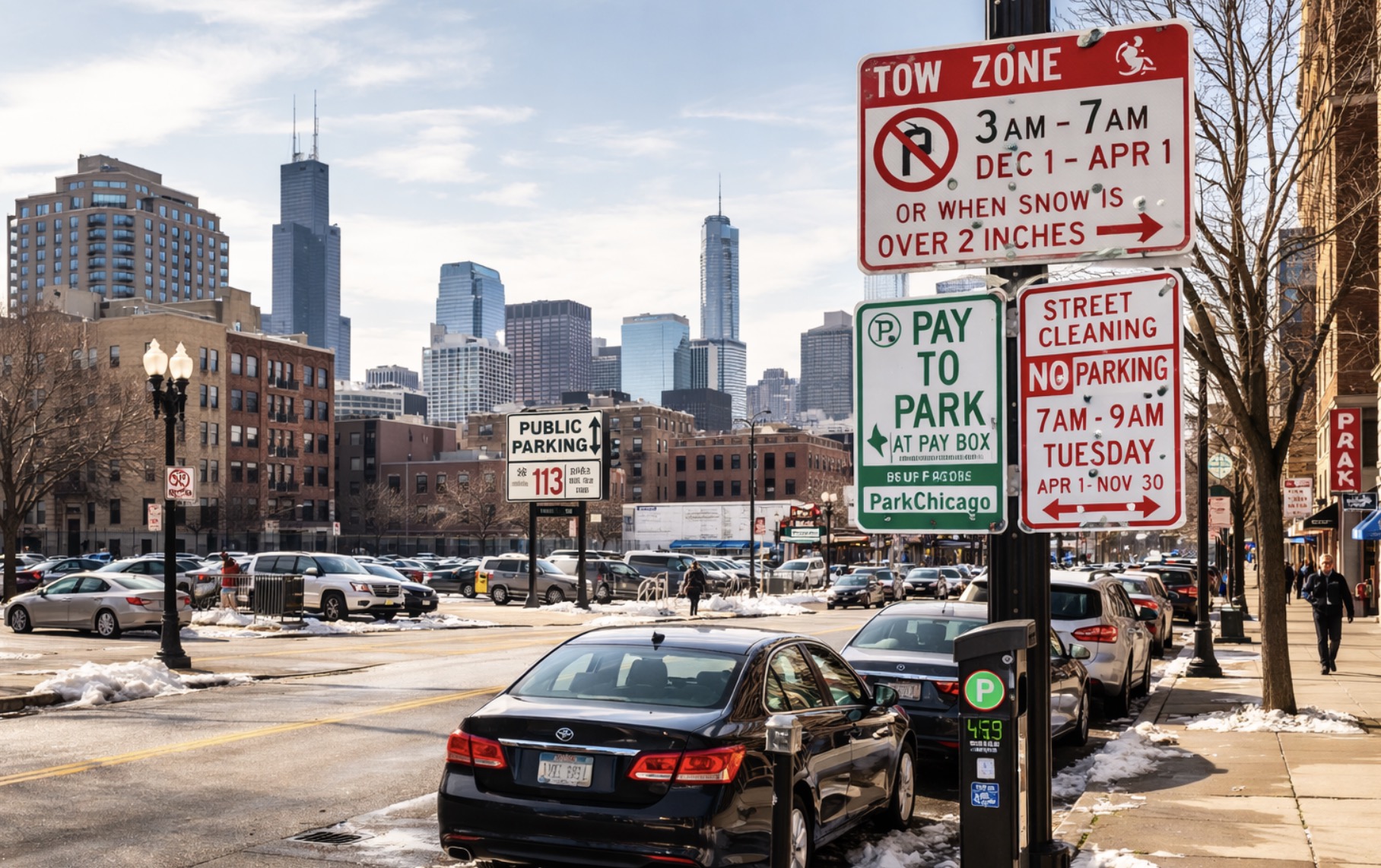
- You need to leave your car untouched overnight in winter without checking signs—some streets are posted as tow zones with overnight restrictions (3:00 a.m. to 7:00 a.m., Dec 1–Mar 31).
- You’re tempted to park on a Residential Zone block near downtown without a matching permit—those zones are for residents/guests with the correct sticker or daily permit.
- You’re trying to “hack it” by ignoring confusing signage—downtown restrictions can stack (meter rules + time limits + posted city restrictions).
🧠 Reality check (what most travelers miss)
Downtown isn’t one set of rules. ParkChicago describes different enforcement patterns by area. The Loop is enforced 24/7, while other areas have longer or shorter operational hours. If you’re building a “free/cheap parking map,” your first step is identifying which tier you’re in—because “free after 10pm” is not universal (especially not in the Loop).
“The app won’t let me pay” does not automatically mean “it’s free.” It can mean the zone isn’t currently charging, but it can also mean you should double-check restrictions. The Chicago Meters help guidance explicitly says to check operational time and restrictions in the app; and if payment is required but the app fails, you should pay at the on-street meter to avoid a citation. Also, don’t ignore winter rules: parking can become illegal on signed Snow Routes when snow exceeds two inches (until snowfall stops and snow operations are done), and some streets are posted as tow zones overnight in winter.
Scenario: You need to park in the Loop (close-in, no guesswork—paying is fine)
| Who this fits | Anyone who values maximum proximity (work meeting, museum day, tight schedule) and is okay paying downtown rates. |
|---|---|
| What to do | Use ParkChicago’s map/app to confirm the zone, then choose either a short-term on-street meter you can monitor, or an off-street option if you need to leave the car for hours. |
| Watch-outs | The Loop is enforced 24/7, so don’t assume a late-night free window. Rates can be high, and additional posted restrictions may exist on the block. |
| Local tip | If your destination is inside the Loop boundary (Wacker Drive to the north/west and Congress Parkway to the south), assume you’re in the highest enforcement tier and verify the zone in ParkChicago before walking away. |
ParkChicago’s own rate guidance shows the Loop as the highest tier, and their operational notes describe it as enforced 24/7. Practically, that means if you’re parking in the Loop for an evening + overnight, you should budget for metered time rather than hunting for “free.”
Two tactical moves that actually help here: (1) make sure you enter the correct zone number from the sign on your side of the street, and (2) if you’re moving around, check whether your purchased time can be shifted to another meter of the same type/rate tier (ParkChicago describes “moving time” rules, but it’s not transferable across everything).
Scenario: Dinner + theater night downtown (your “free parking map” is timing, not location)
| Who this fits | Evening visitors who can handle a 10–20 minute walk (or a short CTA hop) to save money. |
|---|---|
| What to do | Target meters outside the Central Business District where no-pay windows are more likely. Confirm the zone’s operational hours in ParkChicago; if a fee isn’t required, ParkChicago notes the system won’t accept payment. |
| Watch-outs | “Free overnight” is not guaranteed downtown; CBD and Loop tiers can stay enforced later (or 24/7). Also avoid Residential Zone permit blocks unless you have the matching permit. |
| Local tip | Using ParkChicago’s CBD boundary (Roosevelt to North Ave; west edge at Halsted), parking west of Halsted is a common way to exit the CBD pricing tier—then confirm your exact zone in the app/map. |
ParkChicago’s operational overview notes two important “budget windows” that travelers can use: many areas are free overnight (often 10 p.m. to 8 a.m.), and many metered spaces outside the CBD do not require payment on Sundays unless “7 Day Paid Parking” is posted. Your job is to confirm whether the specific zone you’re in follows those patterns.
This is also where Residential Zone tickets happen: if you see a Residential Zone number on the sign, the City Clerk’s guidance is clear that vehicles parked during applicable days/hours must display the correct sticker/permit matching the posted zone number. If you don’t have that, don’t park there—keep walking and re-check the next block.
Scenario: Full-day downtown visit (lowest-budget parking without playing street-sign roulette)
| Who this fits | Families, museum days, sports days, or anyone visiting 6–10 hours who wants a predictable total cost. |
|---|---|
| What to do | Use a CTA Park & Ride lot at an ‘L’ station, pay the posted daily lot rate, and ride the train into downtown (often simpler than stacking Loop meter hours). |
| Watch-outs | Rates, availability, and closures vary by station. Confirm your specific station on CTA’s Park & Ride page before you drive there. |
| Local tip | If you’re coming from the northwest/O’Hare side, CTA lists daily Park & Ride pricing at Cumberland (Blue Line), which can be a practical “leave the car and forget it” option before riding into the Loop. |
CTA publishes a station-by-station Park & Ride list with daily rates. For example, they list Cumberland (Blue Line) daily pricing and time blocks, which makes it easier to budget than stringing together downtown meter sessions.
This approach also sidesteps two common downtown problems: (1) Loop meters being enforced 24/7, and (2) losing time to “searching for a spot” block-by-block. Your trade-off is paying a transit fare and adding ride time—but the parking decision becomes straightforward.
Scenario: Overnight stay downtown with a car (minimize expensive surprises)
| Who this fits | Overnight visitors with luggage, late arrivals, or anyone who wants to avoid moving the car. |
|---|---|
| What to do | Plan on an off-street option for overnight, and treat on-street meters as short-term only. If you must street-park, confirm enforcement hours in ParkChicago before you commit. |
| Watch-outs | Winter rules matter: some streets can be posted as tow zones (overnight restrictions 3:00–7:00 a.m., Dec 1–Mar 31), and “Snow Route” rules can trigger when snow exceeds two inches. |
| Local tip | Before you leave your car overnight, scan for both “Tow Zone” and “Snow Route” signage—those are the two sign types that can turn an “okay spot” into a tow/ticket problem. |
Chicago’s municipal code authorizes the city to post winter tow-zone signs restricting parking between 3:00 a.m. and 7:00 a.m. from December 1 to March 31. If you’re staying overnight in winter, you can’t rely on “it’s late, enforcement is probably done.”
Separately, the code also makes it unlawful to park on a signed Snow Route when snow on the street exceeds two inches, until snowfall stops and snow removal operations are completed. For travelers, the practical rule is: if snow is active or just hit, avoid Snow Route signage altogether.
⚖️ Quick comparison
| Option A | Park on-street inside the Loop (closest, but highest rates and 24/7 enforcement) |
|---|---|
| Option B | Park outside the CBD or at a CTA Park & Ride, then take transit in (cheaper, but adds travel time) |
| Best pick if… | Pick Option B if you’re staying more than a couple hours or you hate ticket risk. Pick Option A only when being steps away is worth the premium. |
If your goal is truly “budget parking,” Option B usually wins because you’re converting an unpredictable downtown meter situation into a predictable “park once” plan. If your goal is maximum convenience (and you can manage the meter rules), Option A is the simplest—just don’t expect “free.”
🎯 Final recommendation
Skip the idea of a single “free parking map” for downtown—it’s Not available in a way that stays accurate day to day. Instead, use this repeatable filter: (1) decide whether you’re parking in the Loop, the CBD outside the Loop, or outside the CBD; (2) confirm the zone’s exact hours/rates in ParkChicago; (3) reject any block with Residential Zone requirements or winter tow/snow-route signage that doesn’t fit your timing.
If you want the lowest stress + lowest cost combo for a long downtown day, use CTA Park & Ride and train in. If you must park close, do it with eyes open: the Loop is enforced 24/7, and the cheapest parking mistake in Chicago is the one that becomes a ticket.
Frequently Asked Questions
Is there any free street parking in Downtown Chicago / the Loop?
Inside the Loop, ParkChicago describes on-street meters as enforced 24 hours a day, 7 days a week. That makes “reliably free” street parking a bad assumption. For budget parking, plan to park outside the Loop/CBD or use CTA Park & Ride.
Are Chicago parking meters free on Sundays?
ParkChicago notes that most Sunday parking is free outside Chicago’s central business district, except where signage explicitly says “7 Day Paid Parking.” Inside the CBD/Loop tiers, Sunday may still be enforced—so always confirm your specific zone.
What does it mean when ParkChicago won’t let me pay?
The Chicago Meters help guidance says a common reason is that the zone may not require payment at that time, and you should check the zone’s operational times/restrictions in the app. If payment is required but the app isn’t working, they advise paying at the on-street meter to avoid a citation.
How do I avoid Residential Zone permit tickets near downtown?
The City Clerk explains that vehicles parked in a Residential Parking Zone during applicable days/hours must display a Chicago City Sticker with the matching zone or a daily residential permit matching the zone number on the street signs. If you don’t have that, skip that block and keep looking.
What is the winter overnight tow-zone rule in Chicago?
Chicago’s municipal code authorizes posted signs restricting parking on designated streets from 3:00 a.m. to 7:00 a.m. during the winter window of December 1 through March 31, designating those streets as tow zones. In other words: in winter, don’t leave your car overnight on a block with tow-zone signage.
What does “Snow Route” mean for parking?
Chicago’s code says it’s unlawful to park on a street designated by signs as a Snow Route when snow on the street exceeds two inches, until snowfall stops and snow operations are completed. If snow is falling or just accumulated, avoid Snow Route signage.
How do I know the exact meter hours and rates on my block?
ParkChicago’s official map tools are designed for this: they describe being able to check specific pay boxes/zones for hours, rates, and details. Confirm it on the block you’re parking on (don’t rely on a neighborhood-wide guess).
Can I extend parking time from my phone?
ParkChicago describes being able to add time remotely during an active session, and the ParkChicago instructions emphasize entering the zone number from the sign where you parked. Always follow the posted restrictions and maximum stay rules for that space.
Leave a Reply